The ultimate balance challenge

Every child should have a slackline in their schoolyard. On a slackline, the body is never completely still. The line moves, balance is disrupted – and the child must constantly adapt and regain balance.
It is precisely this instability that makes the slackline so interesting. Staying balanced requires the senses, muscles, coordination and concentration to work together. And when a slackline is part of the schoolyard, the challenge is there every day – ready for another try.
1. Instability has value
There is no completely stable position on a slackline. The body must constantly respond to movement, make adjustments and regain balance.
The instability creates the challenge – giving the body a task it has to solve.
2. Balance needs practice
Balance is a motor skill that develops through experience and practice. Research involving ten-year-old children who practised slacklining for ten minutes a day, five days a week for six weeks, showed substantial improvement in their ability to balance on the line.
The body learns when it gets to meet the challenge again and again.
3. Body and mind have to work together
It is difficult to balance on a slackline without concentrating on what you are doing. Gaze, body position and movement have to be coordinated while the body continuously adjusts to maintain balance.
Slacklining therefore challenges more than the body alone – body and mind have to work together.
4. Many muscles work at the same time
The legs, hips and core muscles work together to stabilise the body, while the arms are actively used to control balance.
Much of the training happens through all the small adjustments the body makes along the way.
There is no completely stable position on a slackline
5. It brings some of nature’s challenges into the schoolyard
In nature, the ground is rarely flat and predictable. Rocks, roots, slopes and uneven terrain require the body to continually adapt its movements. Research into children’s play in natural environments has shown positive results for balance, coordination and motor development.
A slackline cannot replace nature, but it introduces an important part of the same principle: The environment does not adapt to the child – the child has to adapt to the environment.
6. It’s fun to feel yourself getting better
First one step. Then three. Maybe the whole line.
Progress is easy to notice, bringing both a sense of achievement and a new challenge to aim for. The child tries, loses balance, adjusts – and wants to try again.


7. The challenge is there – every day
No training session needs to be organised. The slackline is simply there during break time, inviting children to be active.
When challenging movement environments are part of children’s everyday surroundings, they have the opportunity to practise little and often – through self-directed activity and play.
Even more fun in a Motor Skills Park
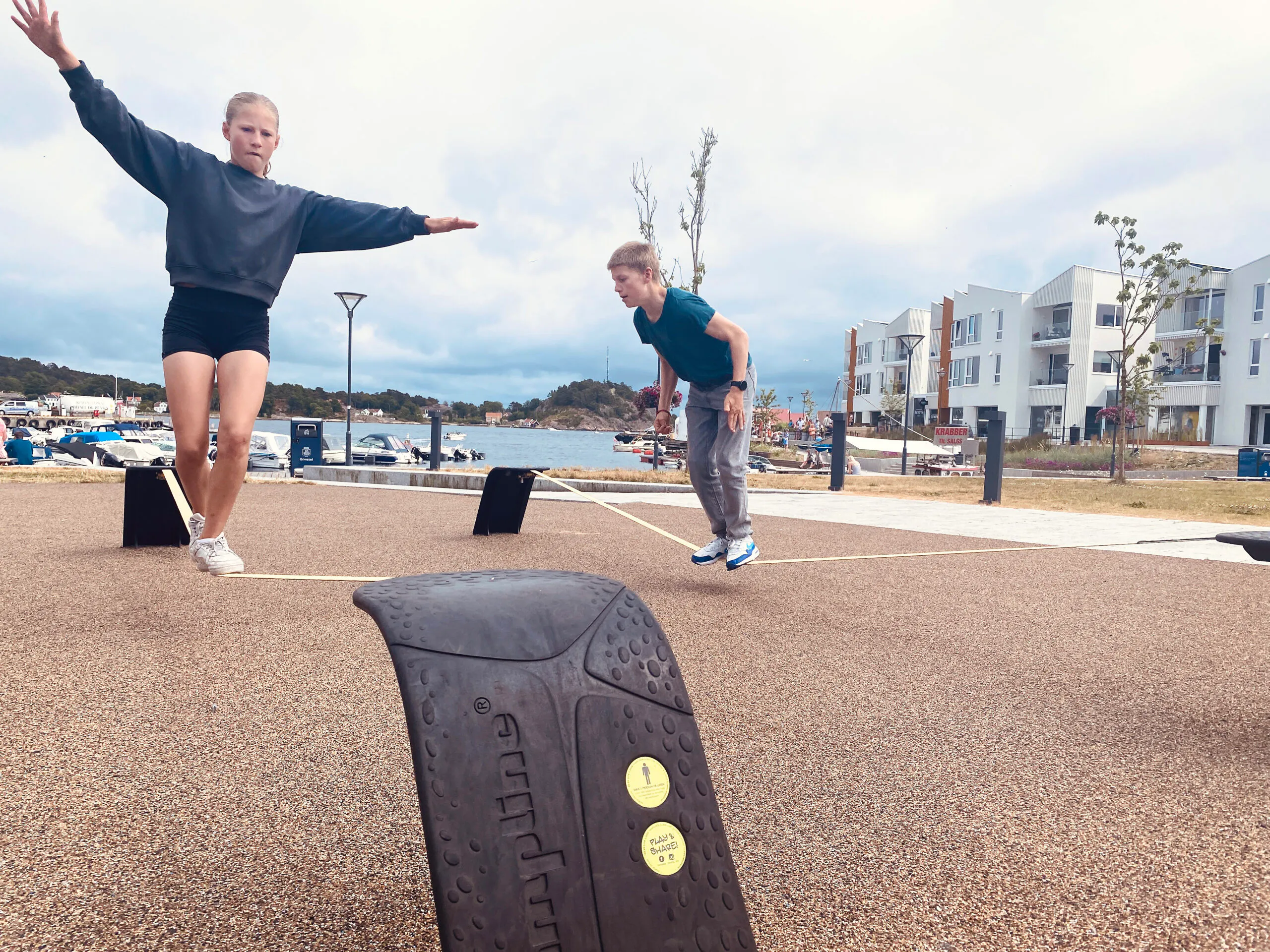
In a Motor Skills Park, the slackline becomes part of a larger movement environment, where equipment is combined into routes and sequences that offer new challenges.
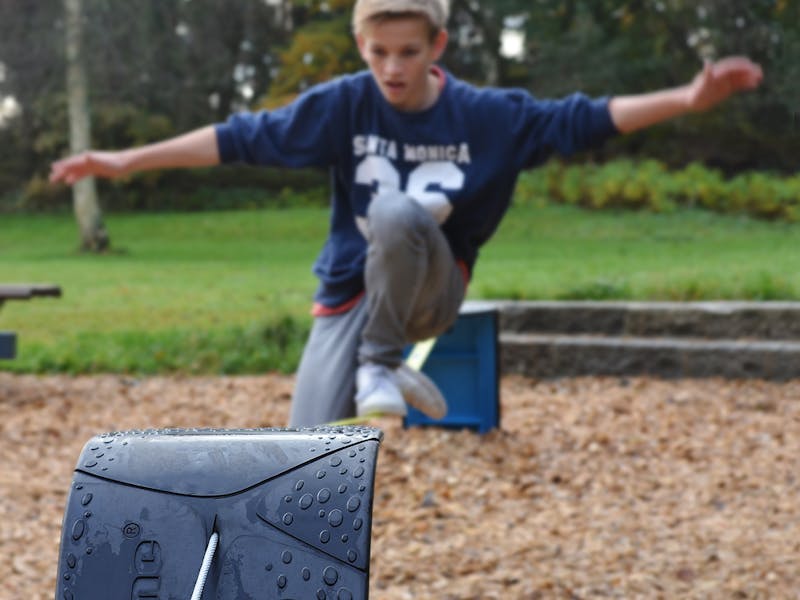
With a little practice, jumping from the slackline onto a moving balance ball – or pushing off from the line and landing on a Fungi – suddenly becomes possible. What seems difficult at first gradually becomes achievable. And that feeling of mastery makes you want to try even more.
Children also need things that aren’t completely stable
A good schoolyard should give children opportunities to encounter movements they cannot master straight away. To lose their balance. Find it again. Try once more. And discover that something that was difficult yesterday is easier today.
Perhaps the schoolyard needs a little more instability after all.
References
Donath, L. et al. (2013). Effects of slackline training on balance, jump performance & muscle activity in young children. International Journal of Sports Medicine, 34(12), 1093–1098. Studie av tiåringer som trente slakkline 10 minutter daglig, fem dager i uken i seks uker.
Donath, L. et al. (2017). Slackline Training (Balancing Over Narrow Nylon Ribbons) and Balance Performance: A Meta-Analytical Review. Sports Medicine, 47, 1075–1086. Meta-analyse av forskning på slakklinetrening og balanse.
Fjørtoft, I. (2004). Landscape as Playscape: The Effects of Natural Environments on Children’s Play and Motor Development. Children, Youth and Environments, 14(2), 21–44. Norsk forskning på naturmiljø, lek og motorisk utvikling.
Fjørtoft, I. & Sageie, J. (2000). The natural environment as a playground for children: Landscape description and analyses of a natural playscape. Landscape and Urban Planning, 48(1–2), 83–97.

SlaCk line iN motor SkillS Park
Slacklines work well with other equipment, combined into routes that create a complete movement environment. Here are a few examples:


-
Copied

-

-